
Sunday, 24 March 2013

Friday, 15 March 2013

Friday, 8 March 2013

Cutting a long story short as the family skied in the glorious Courchevel I sat for nearly a week nursing a broken collar bone. While they had fun I did the usual, pondered Proas. The above is a cruising proa and the earlier one is a minimal proa. The real upset is that last weekend I should have been launching the proa TP03 which was all ready to go but now delayed until the shoulder fixes.
Thursday, 7 March 2013

Minimal
Proa
I have been working on my minimal proa while my
shoulder heals which delayed the launch of TP03
Description,
specification
Minimal
Proa with balanced lug rig and moving leeboard to align CE with CLR. Single
central AKA, nod to Skip Johnson's AC/DC and Bionic Broomstick.
This is a
concept for a possible next build after testing my current proa TP03 and will
help clarify tests and developments to be done with TP03. The other concept I
am interested in is a slightly bigger design with more freeboard and a small
central open concept. This will allow two crew and storage of camping gear. All
other aspects and hence development tests for this concept as per here.
Main hull
•
LOA 12ft
hull, (3.7m) beam and draft 240mm, depth of hull 360mm, freeboard 120mm
•
L/B 15.25
•
Target
weight whole craft 50kg, tough target, but research and a few calculation have
given me confidence
•
Main hull
displacement 150 kg total hull buoyancy 250kg, little reserve but think
about Hobie 16, trimaran floats, swath,
Tepuke etc
•
Deck
section at bows, addition of foam and glass to create wave piercing bow. This
should counter low freeboard and crew fixed in the middle
Outrigger AMA
•
Outrigger
buoyancy 50kg allows for crew at 50% beam
•
LOA 2.6m
(8.5ft) beam 160mm
•
L/B 16.25
Overall beam tbc approx 1.5 to 1.8m
Construction,
•
ply, simple
box
•
plywood and
polyurethane foam bulkheads.
•
All hull
panels 3mm Okoume
AKA
•
3mm egg box
constructed 'box' based on International Canoe sliding seat.
•
Hydrodynamic
box shape lifts AKA 250mm above deck, as a result underside of AKA 370mm above static waterline. This reinforced
box also contains a deep 'bury' for the mast and links righting forces with
heeling forces without loading the hull. Leeboard loads are relatively close.
The only other load being the buoyancy which is obviously spread throughout the
hull. This all helps to produce a light structure.
AKA to AMA connection
•
Two
flexible beams allow movement of AMA relative to main hull
Rig
•
balanced
lug,
•
unstayed
mast,
•
area 8m sq
Steering and lateral resistance,
•
leeboard
mounted on track moves fore and aft to steer by achieving CE / CLR balance
Why's and downsides
•
Proa
(Pacific)
•
Max
performance for given materials, performance means many different things, in
this case it is reasonable speed in a minimal package
•
Downside,
control issues, additional complexity?
•
Minimal
•
Low
freeboard, very light weight,
•
Less
materials
•
Cost
•
Weight
•
Less
room to build
•
Easy
to transport, fastest way to get upwind is behind / on / in a car
•
Easy
to handle on land
•
Downside
low freeboard drag,
•
Downside
low buoyancy limits use; single handed daysail
•
Lug
rig
•
Good
performance for simple set up and small spars
•
Lower
hull stress
•
Less
set up time
•
Low
CE
•
Heeling
•
Pitching
•
Downside
ultimate performance
•
Free
standing mast
•
Lower
stress
•
Stress
all in one place
•
Less
set up time
•
One
central AKA, also the seat
•
Simple
•
Stress
in one place as above
•
Away
from bow so possibly less drag from wave action
•
Less
set up time
•
One
item two uses
•
Downside
can't trim fore and aft
•
Downside
limits to one user
•
Steering
with moving leeboard
•
One
foil only
•
Low
drag
•
Downside
unproven, test with 2b
•
Sharpie
(box construction)
•
Very
simple build
•
Flat
plate, ply, construction
•
Max
buoyancy for box size
•
Helps
leeboard system
•
Bow
sections promote lift
•
Latest
AC, A Class appear to have flatter sections
•
Downside
higher weight and wetted area for buoyancy
Sunday, 23 September 2012
Couple of quick sketches of where the design could go. A development of the current design. Lug rig with moving leeboards. Beam wide like international canoe sliding seat. The colourful one is minimalistic strip planked wave piercing hull. The B&W one wider dory hull with attached outrigger, more a laid back touring / expedition boat.
Back at work so not much movement on the proa, the mast partners are made and bolted on, new leeboard slider made, two new hatch holes cut.
Other news - the number 57 sail - see earlier has now been turned into a 'storm sail' for the RS vision and was used to great effect last Saturday. Slow controlled up wind work and a wet sleigh ride down wind with the asymmetric.


Back at work so not much movement on the proa, the mast partners are made and bolted on, new leeboard slider made, two new hatch holes cut.
Other news - the number 57 sail - see earlier has now been turned into a 'storm sail' for the RS vision and was used to great effect last Saturday. Slow controlled up wind work and a wet sleigh ride down wind with the asymmetric.


Thursday, 30 August 2012


Have been visiting my folks and found two pictures of my first proa. The pictures are taken at the Weymouth speed sailing championships the day after the 1987 'great storm'. I arrived at the week with a very under developed craft with a sort of square rig with poles attached to the foot. The sail moved forward during a shunt using the poles.The position the yard was attached to the halyard was also controllable during the shunt. The hull was asymmetric and steering by weight shift. The helm suspended from a trapeze.
The asymmetric hull's CLR was far to forward for the rig. Also I had great difficulty getting enough luff tension and considering the conditions overnight the sail was cut into a triangle. This was used as a jib with the tack hauled down to the the bow, shutting was by hauling the tack to the new bow. This was a very violent operation with a completely slack luff and storm force winds.
The craft was able to sail upwind in this configuration but failed to complete the speed sailing course, very good fun though. I was only a naive 23 at the time.
One interesting point about the craft was that it had a single beam connecting the hull and outrigger, the mast and stays holding it all together. Weight steering from a trapeze worked well.
However I learnt the hard way how far forward the CLR moves forward on an asymmetric hull and now favour symmetrical hulls and board style lateral resistance control for 'Western' rigs
Friday, 24 August 2012

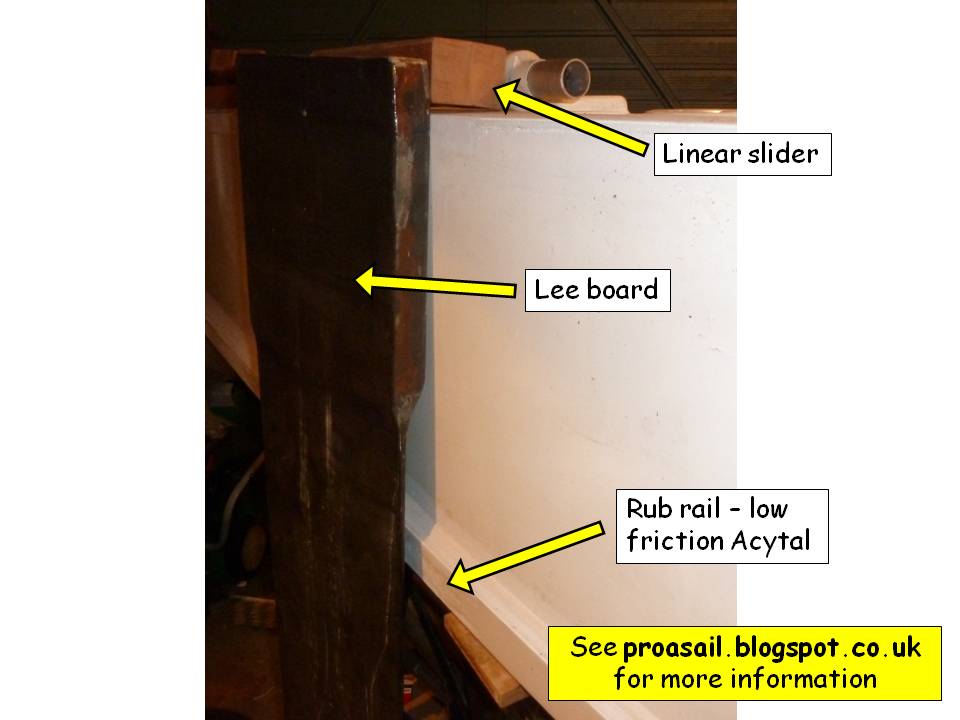
Busy few weeks in the boat shed, garden gate seating platform all finished bar the painting. The mast partners made and dry assembled waiting coating. As detailed above the latest design for the board linear slider all dry fitted, waiting some epoxy work. Have changed to a rigid bar and bearings as it just simplified everything, made it more reliable and feels right.
Subscribe to:
Posts (Atom)